Holiday QR code scavenger hunt for your classroom
The last week before the winter break is a good time for a hunt. Lessons are often short that week, and a hunt keeps students moving without leaving the building.
The ideas below are about winter and about how people in different places celebrate this time of year, so they work in a class where students celebrate different festivals or none. A child who does not take part in holiday activities can still answer a question about snowflakes or about the shortest day. If you are unsure, ask families first, as you would for any holiday activity.
They are written for ages 7 to 13. Answers are in brackets.
In the classroom
- I have hands but I cannot clap, and in the last week of term everyone keeps looking at me. (the clock)
- Count the windows in this classroom. How many are there? (check first; accept the number and the word, such as “6” and “six”)
- In the northern hemisphere, the shortest days of the year come in late December. What is the shortest day called? (the winter solstice; use multiple choice, because “solstice” is hard to spell at this age)
- Snowflakes usually have six arms. As a team, draw a snowflake with six arms on a piece of paper and take a photo of it. (photo)
In the library or the reading corner
- I have a spine but no bones, and I wait on a shelf for someone to open me. (a book)
- Find a book with snow, ice or winter on its cover and take a photo of it. (photo; check first that the library has one)
- Find the books about animals. Name one animal that sleeps through the winter. (check first that the library has some; any real one, such as a hedgehog, a bat or a dormouse)
- How many books can one pupil borrow at a time from this library? (check first; accept the number and the word, such as “5” and “five”)
For the code: ask the librarian before you tape anything up, and keep it away from the desk.
In the corridors and the hall
- I am cold and white, I fall from the sky without a sound, and I usually have six arms. (a snowflake; also accept “snowflakes”)
- Find the noticeboard by the entrance. Write down one event that is on it this week. (check first)
- Go to the office and find out what time school finishes on the last day before the break. (check first; use multiple choice, because a time can be typed in many ways)
- Stand in the hall and record your team wishing everyone a good winter break, in as many languages as you can. (audio)
For the codes: put them where a group of four can stand without blocking a door, and keep the audio stop in the hall, where noise is fine.
Winter festivals around the world
- Hanukkah, the Jewish festival of lights, lasts how many nights? (eight; accept “8”, “eight”, “8 nights” and “eight nights”)
- Which festival starts on 26 December and has seven principles, with one candle lit for each day? (Kwanzaa; use multiple choice)
- In the Netherlands and Germany, children put one of these out before Saint Nicholas Day and hope he will fill it. What is it? (a shoe or a boot; accept “shoe”, “shoes”, “boot” and “boots”)
- On 13 December in Sweden, a girl wearing a white dress and a crown of candles leads a procession. Whose day is it? (Saint Lucia; accept “Lucia” and “St Lucia”)
For the codes: these questions do not depend on a place, so their codes can go anywhere along the route.
Which step type fits each idea
In HedgeHunt each idea becomes a quiz, a task or a mission.
| The idea asks for | Step type | Ideas above |
|---|---|---|
| one short answer you know | quiz, typed answer | 1, 5, 9, 13, 15, 16 |
| an answer from your school | quiz, typed answer, after you check it | 2, 8 |
| one of a few answers | quiz, multiple choice | 3, 11, 14 |
| any real answer in their own words | task | 7, 10 |
| a photo or a recording | mission | 4, 6, 12 |
A typed answer is compared with yours. Capital letters, extra spaces and a “the”, “a” or “an” at the start are ignored. Numbers, and answers under seven characters, must match exactly, so add the other forms that also count, like “8” next to “eight”. A task is checked by AI against what you say a good answer must contain, which is why 7 and 10 are tasks: there are too many correct answers to list. AI also checks the photo missions against what you ask for.
Turn them into QR code stops
- Put a code in front of each question. In the builder, add a mission step, set it to QR code, and drag it in front of a question. The builder makes the code, and its download button gives you a printable card. Teams have to scan the code to open the question, so they have to walk to it.
- Count your steps. A code and its question are two steps. There is no step limit, so build the whole route. Up to 5 phones can play each hunt free every month. If more play, buy a phone pack.
- Start the teams at different codes. In the Player routes panel, choose Multiple start points and turn on each code step as a starting point. It is free. Each phone or tablet that starts the hunt gets the next starting point in turn, so each team plays on one device. Release the hunt again after you change it.
- Print and tape. Eye height, a few metres apart, on plain paper. Laminated codes reflect the lights and are harder to scan. Keep a spare print of every code.
- Play it once yourself. A test run plays the hunt on your own phone, exactly as the students will see it. It is free, and the link lasts an hour.
Scanning needs the camera, and the photo and audio ideas need the camera and the microphone. The browser asks for them the first time. Some school tablets block them, so try one tablet in your test run.
Students play in the browser, with nothing to install and no student account. The by-hand version of a QR hunt, with paper and a free QR generator, is in how to make a QR code scavenger hunt for your classroom. For a review game before a test, see the QR code review game. More on hunts at school is on the classroom scavenger hunt page.
The prompt we used
The prompt
A winter holiday scavenger hunt for a class of 9 and 10 year olds in teams, played indoors around the classroom, the library and the school corridors on the last day before the winter break. Riddles and quiz questions with short typed answers about winter and about festivals celebrated around the world at this time of year, not only Christmas. Cheerful, about 30 minutes in total.
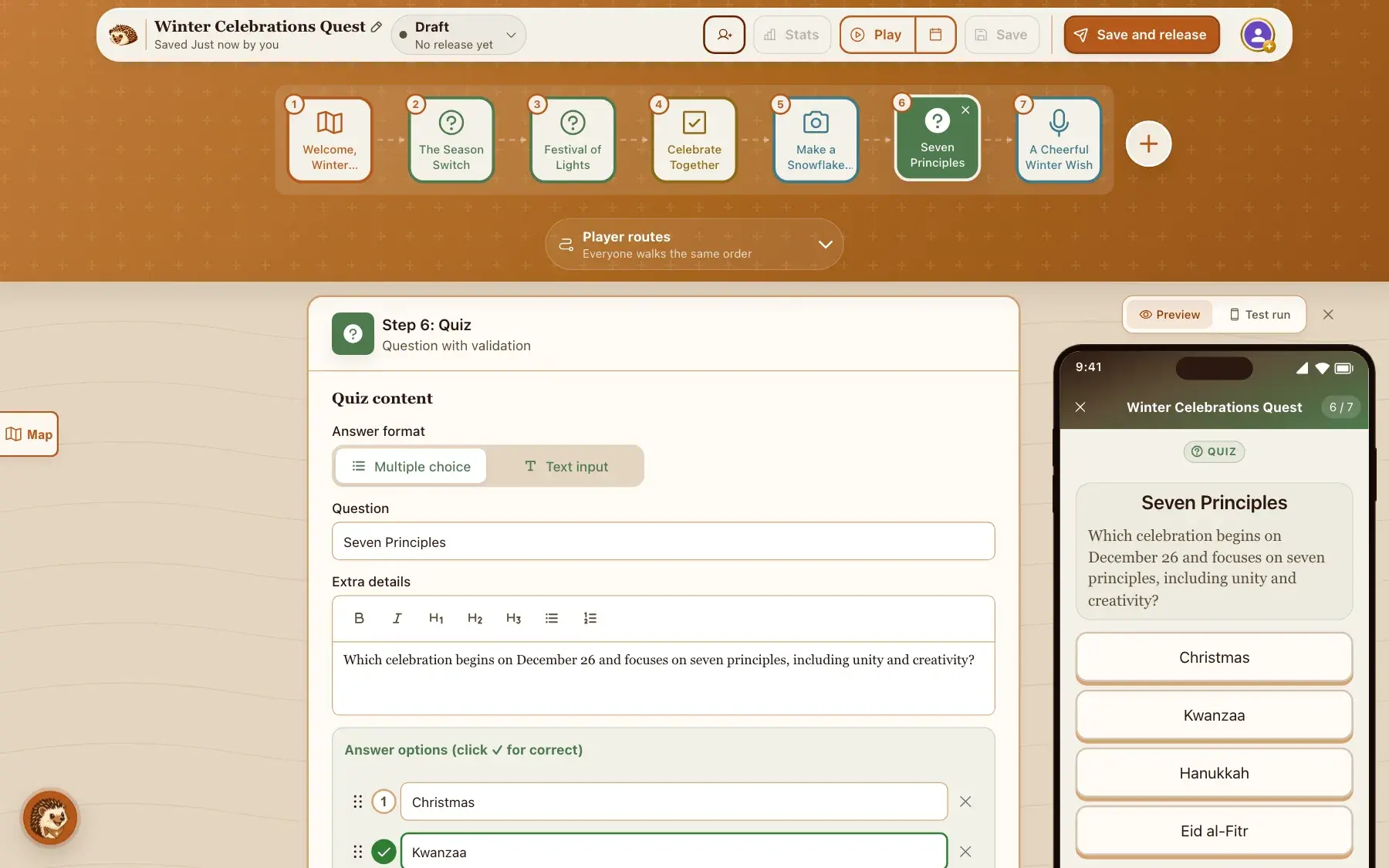
What came back
We ran this prompt twice through the generator, with the place set to Somewhere private. Each run gave seven steps, not eight. The questions covered the winter solstice, Hanukkah, Kwanzaa and other winter festivals, and each run added a photo mission and an audio mission. Neither run wrote a single riddle, although the prompt asked for them. The first run also ended by sending teams to “the person leading the hunt for your final winter surprise”, which only works if you prepare one.
What you will want to change
The button below opens the builder with this prompt filled in, or you can paste it into the AI scavenger hunt generator. Set the place to Somewhere private, so the generator does not send teams to places on a map. Then swap in riddles from the list above and add the QR code stops. The generator never makes QR stops, because it cannot print or place them.
Draft this hunt